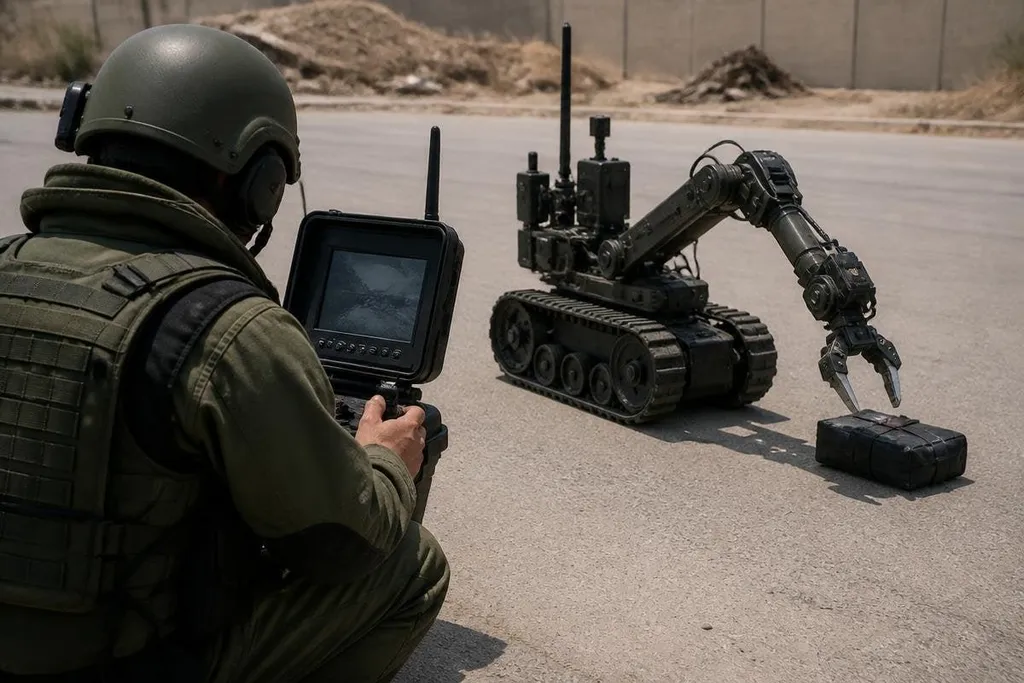
A bomb disposal robot lets a trained operator inspect and handle a suspected explosive from a safer distance. Its cameras, gripper, tracked chassis, and tools turn a close human task into a remote one.
These robots support explosive ordnance disposal (EOD), the work of finding, identifying, moving, or disabling explosives. They don't make the decision alone. An operator still reads the scene and controls the response.
Quick read
- Cameras give the operator a view of the object and the area around it.
- A tracked chassis carries tools across steps, rough ground, and narrow spaces.
- The robot reduces human exposure, but it can't remove every risk.
How the robot handles the job
The operator first drives the robot toward the suspicious object. A tracked base gives it grip on uneven ground, while a low body can pass through doors and around vehicles. The exact shape depends on where the team expects to work.
Cameras show the object from several angles. Some systems use thermal cameras or other sensors when normal video can't show enough detail. A mast camera may give a higher view before the arm lowers to inspect the package, vehicle, or device.
The arm carries tools for different tasks. A gripper can move an object or open a container. A water disruptor can damage parts of an explosive device from a distance. Other tools can cut, lift, probe, or clear material around the suspected device.
Each tool changes the risk in a different way. Moving an object may expose a second device. Cutting may affect wires or switches. A water tool may damage the device without making it safe. The team chooses the method after checking the scene and the likely device type.
Why distance matters
The robot's main benefit is separation. The operator can remain behind cover while the robot takes the first look and carries the tool close to the device. That distance gives the team more time to react if the object moves, breaks, or detonates.
Remote control also keeps people away from places that may contain more than one hazard. A vehicle can hold an explosive, fuel, batteries, or a second device. A building may have unstable floors, broken glass, smoke, or live electrical parts. The robot can check parts of the scene before a person enters.
The robot still needs a clear route and a skilled operator. Stairs, deep rubble, soft ground, and tight corners can stop the chassis. A camera may lose its view when the arm blocks it, and radio signals can weaken behind thick walls or inside underground spaces.
Battery life matters too. The team needs enough charge for the drive to the scene, inspection, tool work, and return. A robot that reaches the device but cannot come back creates another problem for the team.
A bomb disposal team needs more than a robot’s battery figure. A report on Robot24 can place the machine’s tool, camera view, radio link, test site, and operator role beside the result. That record helps show whether the robot can inspect a device, work on it, and return safely before the article looks at where these systems still fall short.
Where the limits remain
A robot doesn't identify every explosive correctly. Its sensors may show wires, batteries, or a container, but those details still need human judgment. The team must also account for blast effects, nearby people, building damage, and the chance of a second device.
Control can be slow when the robot works far from the operator. Video delay makes arm movements harder, especially when the gripper has to touch a small part. A damaged camera, broken track, or lost radio link can end the task before the device is safe.
Training matters as much as the hardware. Operators need practice with driving, camera views, arm control, tool choice, and emergency recovery. The team also needs a plan for what happens when the robot stops in the wrong place.
I’d judge a bomb disposal robot by the distance and control it gives the team, not by the number of tools in its case.
Checks before deployment
A team choosing or preparing a robot should check:
- Route access: Can the chassis cross the floors, steps, doorways, and ground found at likely scenes?
- Camera view: Can operators see the tool, the device, and the surrounding area at the same time?
- Tool fit: Does the arm carry the disruptor, gripper, cutter, or probe needed for the task?
- Radio link: Does control remain stable behind walls, vehicles, or other obstructions?
- Battery plan: Is there enough charge for travel, inspection, tool use, and recovery?
- Failure response: Can the team retrieve or isolate the robot after a track, camera, arm, or radio fault?
Those checks connect the machine to the real task. A robot that works on a clear training ground may struggle beside a damaged car or inside a crowded building.
Bomb disposal robots save lives by keeping people farther from explosives during inspection and tool work. The next useful test is practical: whether a system can keep control when the route is rough, the view is poor, and the radio link is weak.